Research
My research connects gene relationships, spatial molecular programs, cell–cell interactions, and tissue dynamics through interpretable statistical and machine learning models.
01 Gene networks & cellular heterogeneity
I infer gene dependencies from single-cell counts while accounting for measurement noise and differences between cell populations.
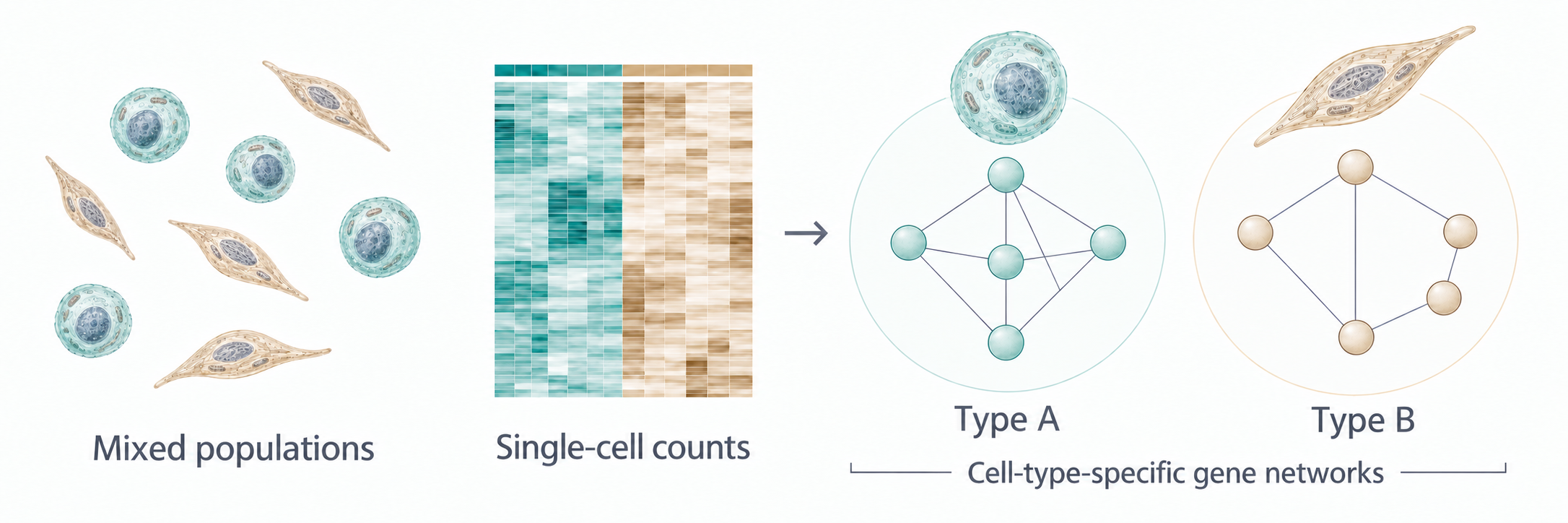
PLNet — gene network estimation from count data. Code
Insight: Count variation and latent gene dependencies should be modeled separately.
VMPLN — cell-type-specific networks in mixed populations. Code
Insight: Pooled cells can mix within-type gene relationships with differences between cell types.
02 Spatial & multimodal representations
I integrate complementary molecular and morphological measurements to connect interpretable biological programs with tissue architecture.
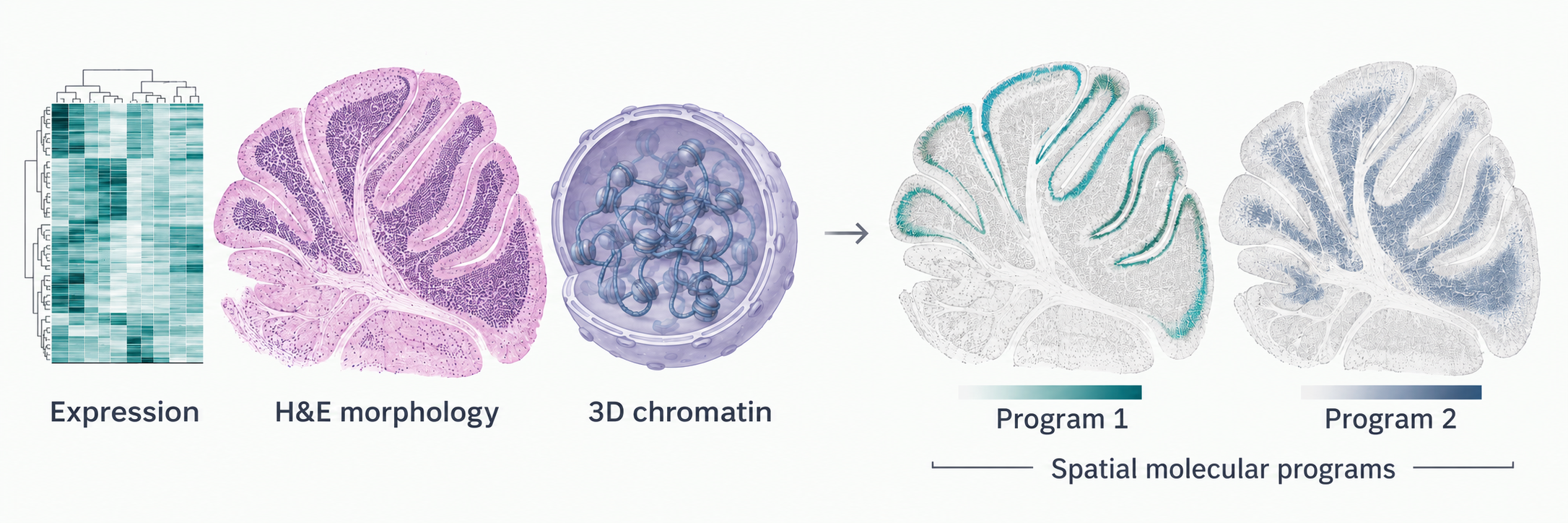
SpaHDmap — high-resolution spatial metagenes from expression and histology. Code
Insight: Tissue morphology can inform molecular resolution while preserving interpretable spatial programs.
Alzheimer’s disease multiomics — a collaborative study of 3D genome organization and gene expression.
Insight: Joint measurements link chromatin reorganization to cell-type-specific disease alterations.
03 Cell communication & tissue niches
I model communication programs, neighborhood composition, and interactions across spatial scales to understand multicellular tissue organization.
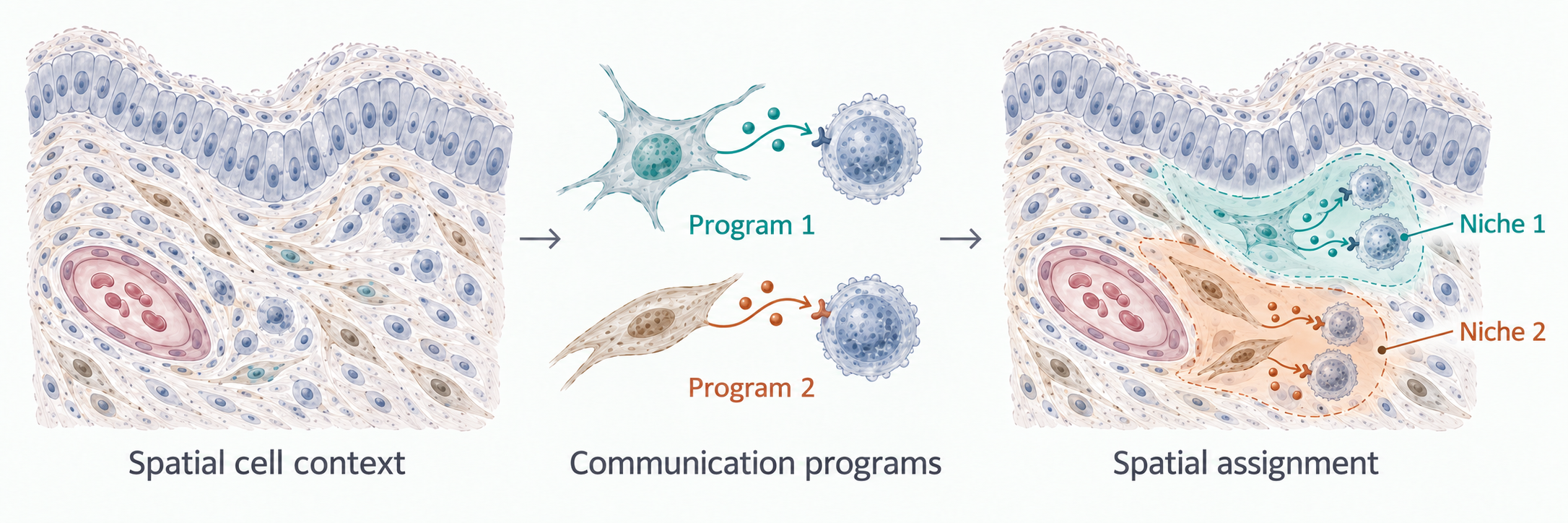
SpiderNet — an interpretable meta-interaction basis for cell–cell communication. Code
Insight: A shared basis separates communication programs from their activity across cell pairs.
SpaNiche — joint analysis of cellular colocalization and ligand–receptor patterns. Code
Insight: Neighborhood composition and interaction patterns together characterize tissue niches.
Steamboat — attention-based modeling of cellular interactions across spatial scales.
Insight: Cell-intrinsic programs, local communication, and long-range interactions contribute distinct information.
04 Tissue dynamics
This ongoing direction asks how molecular programs and cellular interactions change together across space and time, and how those changes relate to tissue responses in aging and disease.
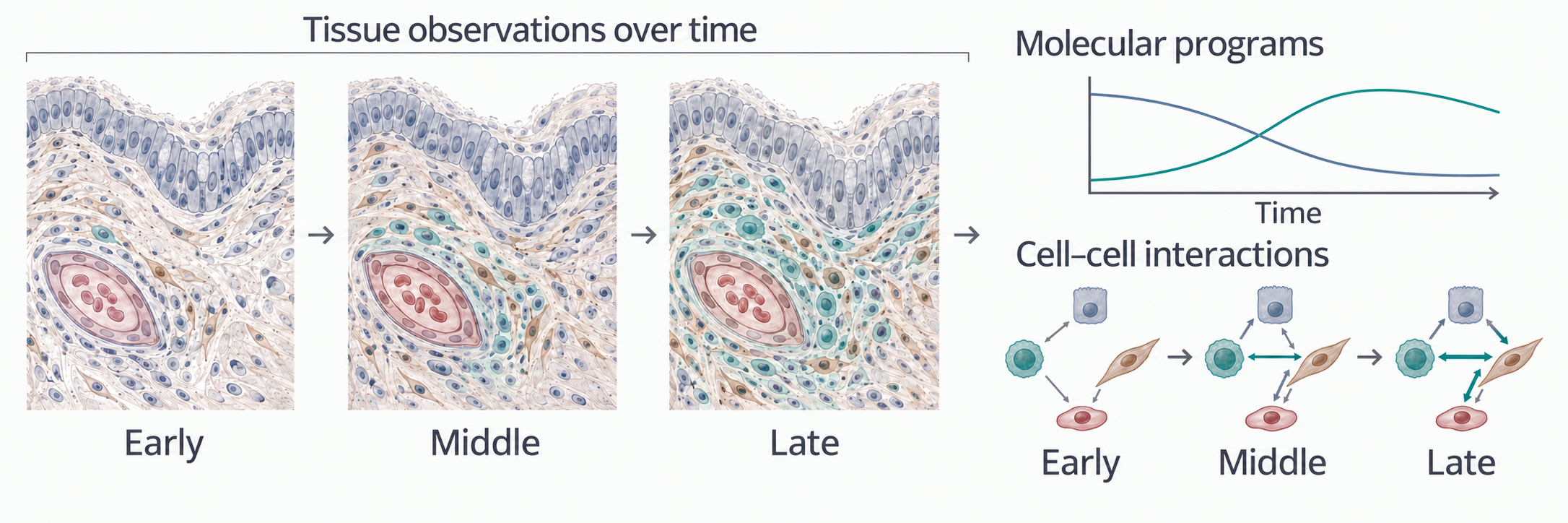
Coordinated tissue change — modeling the temporal relationships between molecular programs, cell interactions, and tissue states.